
Fields in Marion County Property Tax Records
The Board of Tax Assessors handles the appraisal side. It decides taxability, applies approved exemptions, and hears appeals. The Tax Commissioner then bills and collects, so reading a Marion County property tax record by field helps you send an assessment question to the right office instead of the collection desk.
| Field | What It Shows | Where |
|---|---|---|
| Assessed value | Statutory share used as a tax starting point | Board of Tax Assessors |
| Market / appraised value | Assessor's estimate of full value for the year | Board of Tax Assessors |
| Exemptions | Approved homestead or other relief | Board of Tax Assessors |
| Tax bill & status | Charge, payments, and balance due | Tax Commissioner |
| Recorded tax instrument | Lien, release, or tax-sale deed | Clerk of Superior Court |
Two Marion County offices divide the tax record between them. The Board of Tax Assessors decides taxability, sets appraisals, applies approved exemptions, and receives appeals. The Tax Commissioner bills and collects. Read the fields by owner first. That keeps an assessment question from landing on the collection desk by mistake.
Search Marion County Property Tax Values in QPublic
The official Marion QPublic landing page states that its figures reflect the latest published digest. The numbers may change as the county certifies updates. Four search modes are offered there. You can look up an owner of record by name, find a parcel by its location address, search by parcel number, or drill into legal information. Exact field labels on each parcel card vary with the digest cycle. Confirm what you see on screen.
| Search route | Input | Use |
|---|---|---|
| Owner | Name or entity variant | Group parcels under the roll name |
| Location address | Situs street number and name | Find a known site |
| Parcel number | Exact displayed ID | Reconcile tax and deed notes |
| Legal information | Lot, block, subdivision, or land terms | Find land without a clean street match |
The official Marion QPublic landing page notes that its data reflects the latest published digest and can change. The search screen offers four modes: owner name, location address, parcel number, and legal information. Field labels on the parcel card can shift between updates, so confirm what each screen currently shows.
Read Marion County Exemption Entries with Care
The assessor's published exemption guidance lays out homestead, senior, veteran, and local relief options. Marion County materials point to a program for residents 70 and older. Another qualifying school exemption applies at 65. Local HB 918 and HB 919 provisions also tie a value freeze to the parcel. Eligibility and acreage rules shift. Confirm current terms with the appraisal office before relying on any figure.
An exemption flag in Marion County property records can explain a taxable amount. But it never proves a named owner lives at the situs today. People move. Records lag. Save the application, the approval, the tax year, and the dated parcel card. Assessment and billing systems update on different schedules. A document trail beats a single screen every time.
Note: Ask which tax year an approval first affects. Then compare the revised parcel record with an earlier bill.
Follow a Marion County Tax Bill to Payment
Every Marion County tax bill, receipt, collection, and account question sits in one place. The Tax Commissioner handles all of it. Government Window is the linked payment service for online transactions. Have the parcel number and tax year ready before you start. Fall back to the office if the page will not open. A phone call resolves most account questions just as well.
- Find the parcel number and tax year through QPublic.
- Open Government Window and follow its current prompts.
- Ask the Tax Commissioner for the bill or receipt if online access fails.
- Compare the bill with the assessor record and check recorded liens separately.
- Assessed value
- The statutory percentage used before taxable adjustments.
- Mill rate / levy
- Tax per thousand dollars of taxable value.
- Homestead exemption
- Relief for a qualifying primary home.
- Tax lien
- A recorded claim connected with unpaid tax.
Distinguish Marion County Tax Debt from Recorded Liens
The Tax Commissioner keeps the bills, receipts, collections, and account answers. Government Window is the linked payment service. Its entry form may demand a verification step before it opens. Keep the parcel number and tax year close at hand. If the page will not load, fall back on the office itself.
| Question | First source | Needed confirmation |
|---|---|---|
| What remains due? | Tax Commissioner | Dated bill or receipt |
| Was a lien recorded? | GSCCCA lien index | Clerk copy and release search |
| Did a tax sale transfer an interest? | Deed index | Instrument, later deeds, and court filings |
A delinquent account, a recorded tax lien, and a tax-sale deed are related. But they are distinct things. The Tax Commissioner can explain a balance, a receipt, or a collection status. Recorded liens, releases, and deeds live in the Clerk's GSCCCA indexes. A court challenge may open a third file altogether.
Compare Marion County Tax Years After State Law Changes
Georgia DOR's 2024 legislative material describes HB 581 changes to appraisal cycles and tax bills. Its 2025 summary turns to HB 92, plus estimated rollback rates and homestead shifts. Both statewide updates reshape how any Marion County property tax trend should be read. A year-over-year jump may reflect law rather than the market.
Pair each figure with its tax year and certified-roll status. Pair it with exemptions and notice too. A larger fair-market estimate does not set the bill increase alone. A smaller taxable amount may signal relief, not a market decline. Context carries the comparison.
Contest a Marion County Property Tax Assessment
Georgia DOR's 2024 legislative material describes HB 581 appraisal-cycle and tax-bill provisions. Its 2025 summary addresses HB 92 and estimated rollback-rate and homestead changes. Those are statewide shifts. They change how a Marion County property tax trend should be read across years.
Pair every figure with its tax year, certified-roll status, exemptions, and notice. A bigger fair-market estimate does not announce the bill increase alone. A smaller taxable amount may signal relief. That is relief, not a falling market.
Appeal window. File within the 45-day notice period and keep proof of delivery; a payment inquiry does not lodge an assessment appeal.
On the PT-311A form, you supply the digest year, the property ID or account number, and a description of the parcel. You also give the ground for appeal, your own value assertion, and the review route you want. Several routes exist. You can go to the Board of Equalization, or choose arbitration for a valuation dispute. You could use a qualifying hearing officer, or file directly in Superior Court by consent. Evidence matters here. Comparable parcel records support an appeal. Photographs and repair facts help too. So does a copy of the notice.
Confirm Marion County Appraisal Field Review
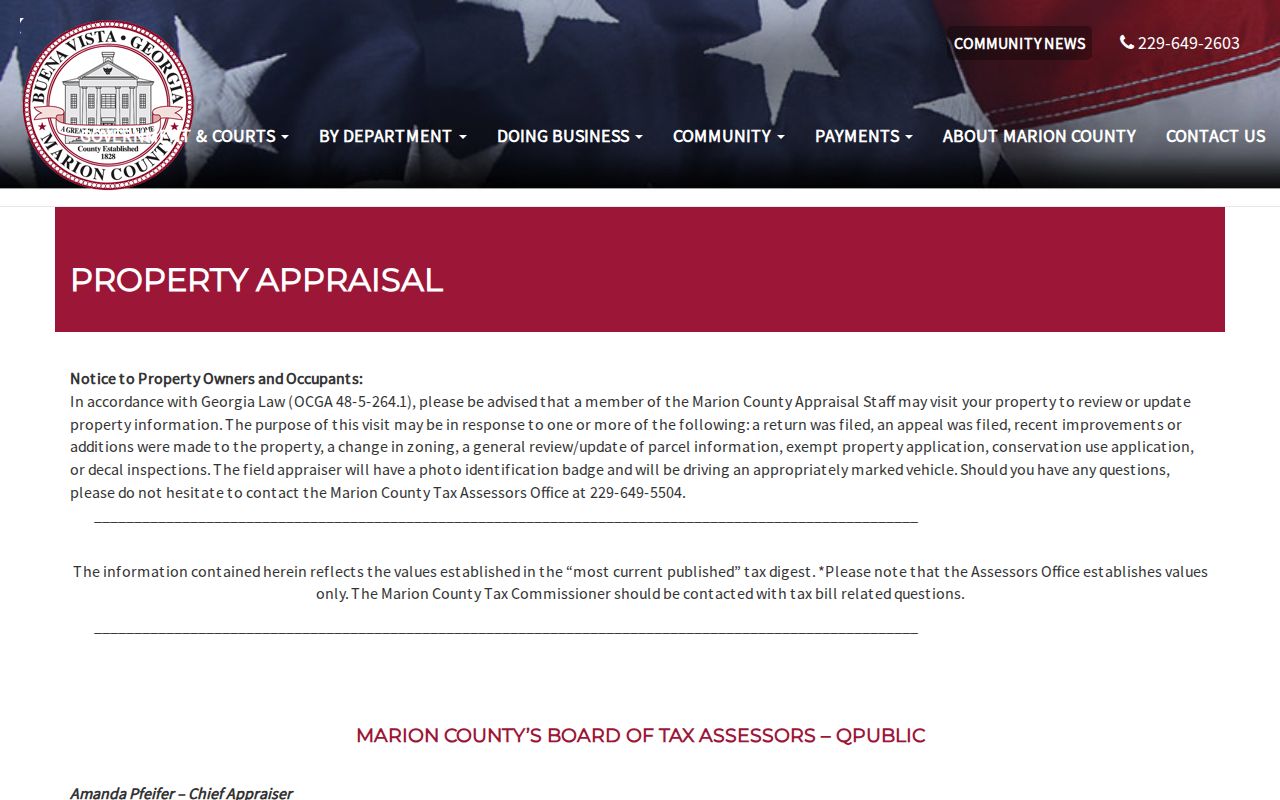
The county property-appraisal office page posts a field-review notice under O.C.G.A. §48-5-264.1. Appraisers may visit during normal business hours. They review sales, permits, conservation use, or parcel characteristics. The notice also describes how they identify themselves at the door.
If a visit or message seems unusual, call the assessor's published number yourself. That office handles all appraisal questions. The Tax Commissioner cannot revise a value. Weekday hours run 8 a.m. to 5 p.m., closing from noon to 1 p.m. Time any call accordingly.
Keep the evidence boundary. A tax card or bill is not an appraisal, boundary survey, or title opinion.
Use Every Marion County Property Tax Access Channel
Online results are just one channel in Marion County. The assessor answers by phone, fax, and email. Its office sits at 100 Burkhalter Avenue. The Tax Commissioner lists an office at 100 E Burkhalter Avenue plus a postal box, phone, and email. Both close at noon on weekdays. Call before you travel. Confirm that the digest, bill year, receipt, or exemption file you need is available.
A written request under the Georgia Open Records Act should name the parcel, the owner if known, the tax year, the exact record, and a preferred electronic format. Georgia agencies usually respond in three business days. The agency produces the record or explains availability, cost, and any exemption, but it need not build a custom tax summary. Copy charges can reach $0.25 per page. Search or retrieval time may be billed after the first 15 minutes under the Attorney General's guidance.
Ask the assessor for a parcel card, value history, exemption status, appeal notice, or field-review record. Ask the Tax Commissioner for a bill, receipt, payment history, delinquency status, or sale notice. The Clerk holds recorded liens, releases, executions, and tax-sale deeds. Narrow routing cuts delay. Bill answers are not title answers.
The Tax Commissioner page shows the billing office and its payment link.

The Tax Commissioner's official page is a reliable fallback when the interactive payment form is unavailable. It confirms the custodian and the contact route. The county property-appraisal page names the office that sets values and handles exemption and appeal issues.
Every access channel in Marion County serves one practical split. Appraisal questions go to the assessor. Payment questions go to the Tax Commissioner. Keeping that division straight puts each request with the right custodian the first time.
For an appeal file, request the annual notice and any work papers tied to the parcel. Then organize the evidence around the ground selected, since a value claim differs from a uniformity claim. An exemption denial raises different questions. So does a covenant issue. The PT-311A routes differ as well. The Board of Equalization route preserves a Superior Court appeal. Arbitration covers valuation only, and a hearing officer is limited to qualifying property. Confirm the correct route before filing.
For tax-sale research, ask the Tax Commissioner for the dated sale notice and account status. Then search the Clerk's land and lien indexes. A quiet-title, foreclosure, confirmation, or lien-enforcement dispute may have followed, and the Marion Superior Court file can add pleadings and orders through Georgia Courts eAccess or a clerk request. Read each record by date and parcel description.
Keep the receipt and the tax record separate. A receipt shows payment activity. It does not state market value. It cannot prove a boundary, identify every ownership interest, or replace a recorded release. The distinction matters when a payment portal, an assessor card, and a deed index show similar parcel or owner text yet answer different legal questions.
The assessor's general-information and forms pages help before an office visit, connecting applicants with exemption materials, appeal guidance, and state forms. Use the version the county currently links. Filing rules and legislative provisions can change. A prior approval or blank form proves nothing about current requirements. When comparing bills, copy the taxing district and every levy line rather than the total alone. A parcel inside Buena Vista can sit in a different jurisdiction from land carrying a Buena Vista mailing label outside city limits. A ZIP code is not a tax boundary. Ask the assessor to confirm the district when the city line matters.
For mobile homes, timber, personal property, and real property, the Tax Commissioner lists collection duties across distinct account types. Match the record to the parcel at issue. A name match can combine unrelated obligations. Check the property ID or account number against the situs and legal description before paying.