
The Marion County Current Owner Record Card
Marion's QPublic parcel card is the practical present-tense record. Read its fields against the tax year and the published-digest disclaimer, because ownership and assessment systems do not refresh at the same moment. They update on different clocks.
| Owner Name | The party carried on the latest published assessment roll |
|---|---|
| Mailing Address | Where tax correspondence is directed |
| Situs Address | The location assigned to the property |
| Parcel Number | The stable key used to reconcile county records |
| Last Sale Date | A transfer clue that should be checked in the deed index |
| Deed Reference | Book/page or related lead when shown |
An owner name and a tax-mail address do not prove occupancy. They show whom Marion County's assessment system links to the parcel. A trustee, company, or estate may receive mail elsewhere entirely. So may an absentee owner who never lived on the land.
Check How Current Marion County Owner Data Is
The Marion QPublic site states that its data reflects the latest published digest and may change. That language matters after a closing. A deed can be recorded before the assessor's certified roll displays the new grantee, and a parcel card can carry newer assessment facts without settling every title question. Record the tax year, the date you searched, and any last-sale reference. Then check the GSCCCA good-through status. Marion County's index has reported a five-day lag. That figure moves. Treat it as a live number, never a permanent one.
Confirm the Current Marion County Owner
Verification means comparing the roll with the newest relevant conveyance, not retracing the entire ownership history of the parcel. Keep the parcel and legal description fixed throughout.
- Read the owner name, parcel number, situs, and tax year in QPublic.
- Search that name as grantee in the GSCCCA Marion deed index.
- Compare the newest recording date and legal description with the parcel card.
- Resolve an entity through Georgia eCorp or an estate through Probate Court.
- Owner of record
- The party named on the current assessment roll.
- Recording lag
- The time between a deed filing and a later roll update.
- Registered agent
- A public entity contact, not necessarily the property owner or occupant.
Use Marion County's Latest Grantee Entry
The GSCCCA real-estate search lets users choose Grantor, Grantee, or All Parties, filter by instrument type, limit the county, add a date range, and change how results display. Start with the assessor name as grantee. Focus on the newest plausible deed. Match the book and page, recording date, grantor and grantee, instrument type, and property text. Marion County's recorded index reaches back to January 1, 1987. Images or deeper access may require an account. The Clerk's courthouse terminal and office-copy route still work.
Note: A deed-index hit is evidence to inspect, not a guarantee against later corrections, releases, court orders, or unrecorded interests.
Verify a Marion County Current Owner That Is an Entity
LLCs and corporations need a second step. When the roll names an entity, search the exact name in Georgia eCorp. Starts With, Contains, and Exact Match modes help resolve punctuation gaps and name changes. Preserve the control number, status, filing date, registered agent, and exact legal name. The agent is a contact point. That person is not proof of who occupies the parcel or controls every decision. Trusts are different. The recorded deed may name the trustee. Estates run through Probate Court. It may show the representative's authority. Any current conveyance still has to be reconciled with the Marion County Clerk's index.
Separate Marion County Mailing and Situs Addresses
The situs pins down where the land sits. The mailing address tells the Marion County tax office where to send notices. The two can differ. Rural acreage, vacant land, companies, trusts, estates, and absentee owners all produce mismatches. Use the parcel number and legal description. They show whether two records describe the same land. Never toss a deed over mismatched address wording. Older Marion County descriptions lean on land lots, roads, creeks, and acreage. They also use adjoining owners rather than postal labels.
Build a Marion County Current Owner Packet
A tight packet keeps facts from blurring across systems. Save a dated parcel card, the newest deed-index entry and any deed image, the parcel number with its legal description, and any entity or probate result. Tag each item with the tax year. Add the GSCCCA good-through date.
| Item | Present-tense use | Freshness check |
|---|---|---|
| Parcel card | Current roll name and contact address | Tax year and digest notice |
| Latest deed | Newest recorded grantee | Recording and indexing dates |
| Entity filing | Exact company identity | Status and filing date |
| Probate paper | Representative authority clue | Case and order date |
The packet supports due diligence. It is not a title examination, so ask the Marion County Clerk for a certified copy whenever the document itself matters.
Contact a Marion County Owner of Record Lawfully
The tax-roll mailing address is the county's practical contact clue for property correspondence. It may differ from the situs. Call it a mailing address, never a residence. Protected details can be redacted, and Georgia VoteSafe can shield an eligible voter's address from the public voter list.
Lawful use. Use a public mailing address for legitimate property communication. Never use owner data to threaten, harass, or bypass address protections.
Online access can fail. The Marion County assessor can then produce the current parcel card by office inquiry. The Clerk can search the courthouse terminal, paper books, or microfilm and provide plain or certified copies. A narrow Open Records request can seek an existing electronic parcel card. It can also seek a named instrument. The county need not create a new owner report.
Bring the situs, parcel number, legal description, current roll name, and approximate transfer date. Ask which date controls each result. If the owner is protected, accept lawful redactions. Never try to rebuild a withheld address from unrelated public sources.
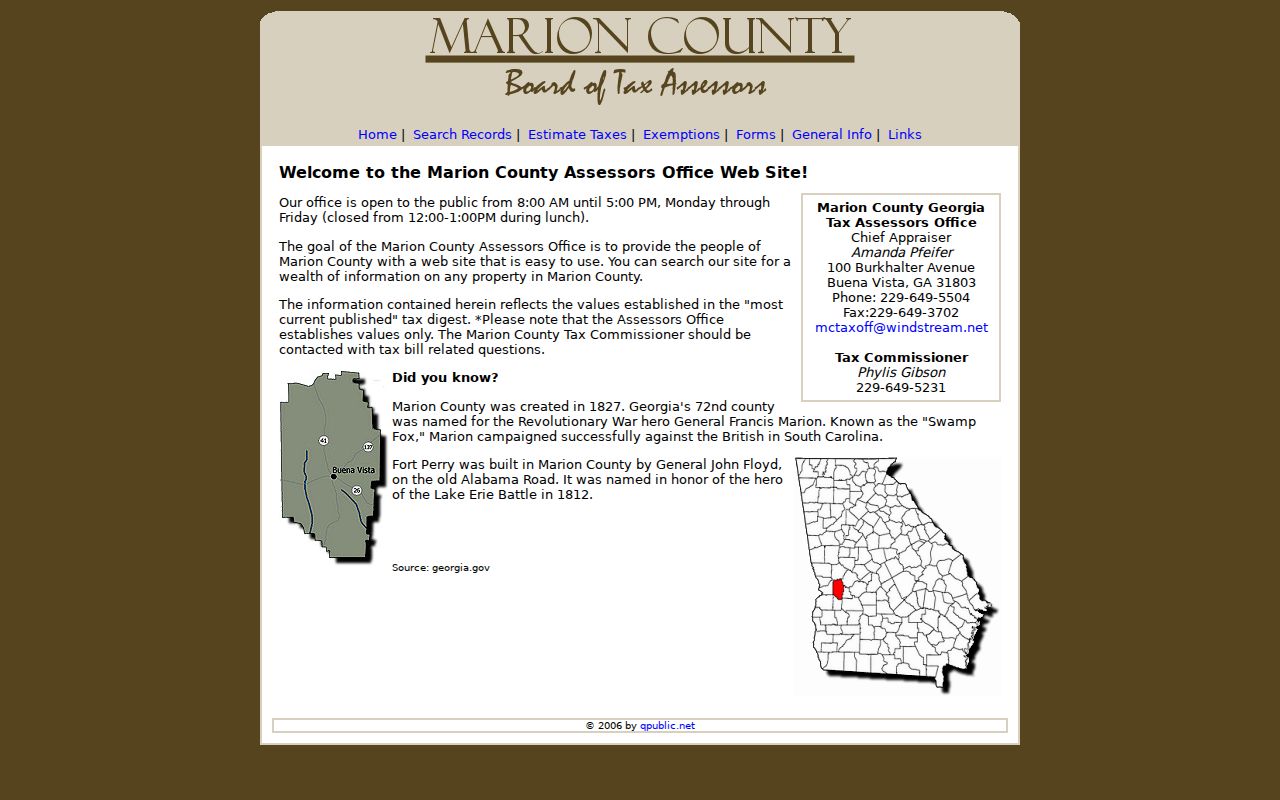
The Marion assessor landing page is the documented owner-record doorway.
The online digest is a snapshot. The newest recorded deed is still the real test of a recent ownership change. Instrument type matters just as much when researching a current owner. A warranty deed, quitclaim deed, trustee's deed, executor's deed, foreclosure deed, or tax-sale deed can put a name in the grantee field. The reasons behind each one differ greatly. Read the document itself, plus any later filings, before assuming the label describes an uncontested interest. Security deeds, assignments, liens, and releases often name lenders or other parties without making them the tax-roll owner. When the question is who owns the property now, focus on the conveyance that vested the grantee. Also check for any later corrective deed or court order. Full lien analysis is a separate record trail.
A homestead or local exemption flag on the parcel is a dated assessment clue. It may hint at a primary-home claim for that tax year, but it does not prove anyone lives there today. The assessor's exemption page describes homestead, senior, veteran, and local programs, and eligibility should be confirmed directly with the office.
A current owner check can fail on spelling alone. Search initials, spouse names, trustee styles, estate captions, and exact entity variants. GSCCCA instructs individual users to enter last name, first name and allows a party-role choice. Before accepting a negative result, inspect the county good-from and good-through status. If a legal decision depends on the outcome, get the deed itself, certified if needed. The Clerk can locate and certify records. County staff cannot run a title search or advise whether an instrument conveys good title.
Put a date in every note. Record when QPublic was checked and which digest year it showed. Note when the deed was recorded, and how far behind the GSCCCA status page reported the index. A clean date trail explains most recent-sale mismatches. It also keeps an older saved card from being presented as today's owner record. If the newest instrument is missing online, report the image problem through GSCCCA. Ask the Clerk to compare the index against the original. Statewide indexing and virtual-microfilm work is ongoing. Online coverage is an evolving access layer, not proof that the courthouse record is absent.