
Compare Marion County Property Value Types
Each value record holds measures that answer different questions.
| Value | What It Is | Where |
|---|---|---|
| Assessed value | The statutory share used for taxation | Assessor parcel record |
| Fair market value | The assessor's full-value estimate for the year | Assessor parcel record |
| Last sale price | Consideration from a prior transfer when reported | Recorded deed or assessor sale field |
| Land vs improvement | The mass-appraisal split between site and structures | Assessor detail |
Most taxable property in Georgia is assessed at 40 percent of fair market value. That is tax math, not market proof. Exemptions shape the tax bill, not the fact of a prior sale, and a deed's recorded consideration can reflect special terms or interests that defeat a casual comparison.
Apply Georgia's 40 Percent Rule to Marion County Value
The Georgia Department of Revenue explains that property is generally assessed at 40 percent of fair market value. Two figures sit on a parcel card. It does not recreate the tax bill. Exemptions and millage belong to the separate tax calculation.
The ratio is a statutory relationship, not a market discount. Avoid setting an assessed figure beside another parcel's full fair-market number. Neither number is a sale price. Match the value type and tax year on both sides.
Look Up a Marion County Property Value
QPublic serves as the official assessor doorway for Marion County. Search the parcel, note the tax year and the published-digest disclaimer, then inspect the value components before weighing any sale reference.
- Search Marion QPublic by situs address or exact parcel number.
- Record fair market, assessed, land, and improvement figures with the tax year.
- Check exemptions and parcel characteristics that affect interpretation.
- Use GSCCCA to verify the deed date and any sale consideration shown.
- Assessed value
- The statutory portion used in the tax framework.
- Fair market value
- The assessor's full-value estimate for that tax year.
- Assessment ratio
- The share of fair market value assessed under state law.
Read Marion County QPublic Value Fields
The official Marion QPublic page states that its data comes from the latest published digest and can change. Search modes cover owner, location address, parcel number, and legal information. Field labels on a parcel card may vary. Confirm exact current labels with the assessor.
| Value field | Reading question | Context to save |
|---|---|---|
| Land | How much value is allocated to the site? | Acreage and land class |
| Improvements | How much is allocated to structures? | Sketch and property characteristics |
| Fair market | What full-value estimate did the assessor publish? | Tax year |
| Assessed | What statutory share appears? | Ratio and exemptions |
QPublic sometimes fails. The assessor's office sits at 100 Burkhalter Avenue in Buena Vista. Call 229-649-5504 with questions. Hours run weekdays 8 a.m. to 5 p.m., closing from noon to 1 p.m.
Compare Marion County Property Value with a Recorded Sale
The GSCCCA deed index supplies the parties, instrument type, recording date, book and page, and property text for a transfer. A sale price may appear in the deed itself. It may appear in the assessor's sale field. Neither source guarantees a figure. Never manufacture a price, and never assume every transfer is an arm's-length sale.
Quitclaim, estate, trustee, foreclosure, and tax-sale deeds often reflect transfers that are poor evidence of market value. Match the legal description first. Then match the date. Read the instrument before using its consideration as a benchmark.
Note: Marion's deed index reaches January 1, 1987, but online images and search access may require a GSCCCA account or a courthouse terminal.
Track Annual Review of Marion County Property Value
Georgia sets no single statewide revaluation date. Assessors review sales and parcel facts as part of maintaining each county digest, so a permit, field review, correction, or changed market evidence can move a Marion County value without any deed transfer.
The county appraisal page publishes a field-review notice under O.C.G.A. §48-5-264.1. Staff may examine sales, permits, conservation use, and parcel traits during normal hours. Any unexpected visit deserves a check. Confirm it through the office's published contact.
Compare Marion County Values Across 2024 and 2025
Recent state legislation can bend a casual trend line. Georgia DOR's 2024 summary describes HB 581 appraisal-cycle and tax-bill provisions. Its 2025 summary addresses HB 92, rollback rates, and homestead changes. These statewide developments shape how Marion records should read.
Compare like with like. Hold the value type, parcel configuration, tax year, exemption status, and legal framework constant. Taxable value can shift because of relief. Full value can shift because of appraisal review. Neither shift alone states a current sale price.
What Marion County Assessed Value Cannot Predict
The assessor uses mass appraisal. Real sales can differ. Parcel condition, transaction terms, timing, and market can push an actual price away from the roll, which may lag physical changes or a recent transfer.
Value is not price. Marion County assessed value does not predict a sale. Obtain a property-specific appraisal when a present market opinion matters.
A sound value file holds the dated parcel card and the land and improvement split. It should also show acreage, legal description, tax year, exemption status, and last-sale reference. Include any permit or physical-change record. Property type matters too. Vacant tracts, mobile homes, agricultural uses, conservation covenants, and split parcels form their own classes. They should never be compared casually with a different class of property. Compare within one property type.
The assessor takes inquiries at 100 Burkhalter Avenue in Buena Vista. Phone 229-649-5504. When online access fails, request the parcel card and value history in electronic form. The Georgia Open Records Act offers another channel. It cannot compel a new appraisal, comparable-sales study, or custom valuation report, however.
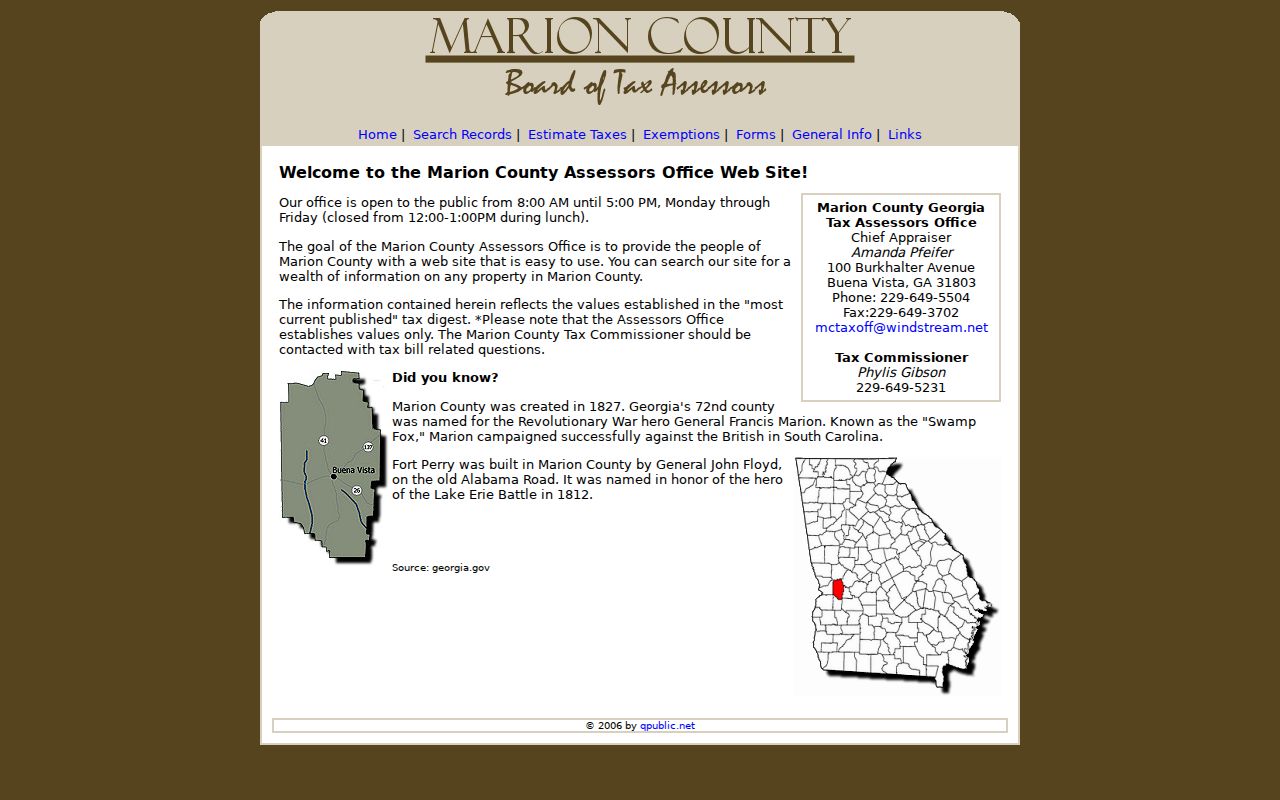
The Marion QPublic landing page is the official published-value entry. Every search starts there.
Exemptions explain why taxable value can diverge from published fair-market or assessed figures. Marion materials describe homestead relief, senior relief, veteran relief, local age-based relief, and a local freeze. Eligibility and acreage limits vary. Confirm an exemption for the stated year rather than projecting it forward.
When a figure looks wrong, keep the assessment notice. Use the county appeal route within 45 days. That procedure belongs to the tax-record process. Still, it matters here as the formal way to challenge a value of record. Filing with the Tax Commissioner does not substitute for an appeal to the Board of Tax Assessors. Discussing a bill does not substitute either.
Historic context is not an appraisal. The regional plan reported major shifts in the county. It also reported shifts in the Buena Vista residential unit mix between 1980 and 2000, including growth in mobile homes. Those figures describe an older population of units. They say nothing about the current value of any parcel. Use them to frame research questions, never to calculate a present estimate.
Parcel changes also weaken comparisons. A lot split, combination, new improvement, demolition, conservation use, or boundary correction can make the record behave oddly. The same parcel number or acreage may behave differently across years afterward. Compare the legal description and the land and improvement allocation before treating the record as a continuous series.
For a purchase decision, a value record is one piece of due diligence. Inspect the property. Read the deed and plat. Review permits where relevant, and obtain qualified valuation or legal help. County values are public administrative records, not warranties about condition, access, title, or future price.
Keep the Tax Assessor and Tax Commissioner roles separate. The assessor sets appraisal and assessment data, approves exemptions, and receives appeals. The commissioner issues and collects bills. A billing correction does not necessarily change the value field. A successful assessment change may take time to appear in the collection system.
Note: When documenting Marion County property value, cite the parcel and value type. Include the tax year, source, and access date in one line. That habit shows whether a figure is fair market, assessed, taxable, or sale-based. It also keeps an old screenshot from being mistaken for a current appraisal.