
Identify Who Owns a Marion County Property
Finding the owner of record in Marion County works best as a short chain of evidence. Begin with the official QPublic parcel entry. That parcel record carries stable identifiers, such as the parcel number. These hold up across systems. Carry those identifiers into the recorder's deed index next. Only then resolve an entity or estate name. A broad name search alone can mislead.
- Search the situs address in Marion QPublic and copy the parcel number and owner-of-record name.
- Search that owner as grantee in the GSCCCA Marion real-estate index and identify the newest deed.
- Match the deed's legal description, recording date, and book/page to the parcel.
- For a company, use Georgia eCorp to confirm the exact legal entity and filing status.
Read Marion County QPublic Owner Results Carefully
The assessor's QPublic page is the everyday starting point for a Marion County property search. It supports owner, location-address, parcel-number, and legal-information lookups. The data reflects the latest published digest. So note the tax year and the disclaimer beside the owner name.
A good parcel card shows owner of record and tax mailing address. It also lists situs address, parcel number, legal description, acreage, values, exemptions, and a sale reference. The online application is sometimes unavailable. The assessor's phone line and office counter remain practical fallback channels. The official Marion assessor landing page is the online entry point for every lookup.
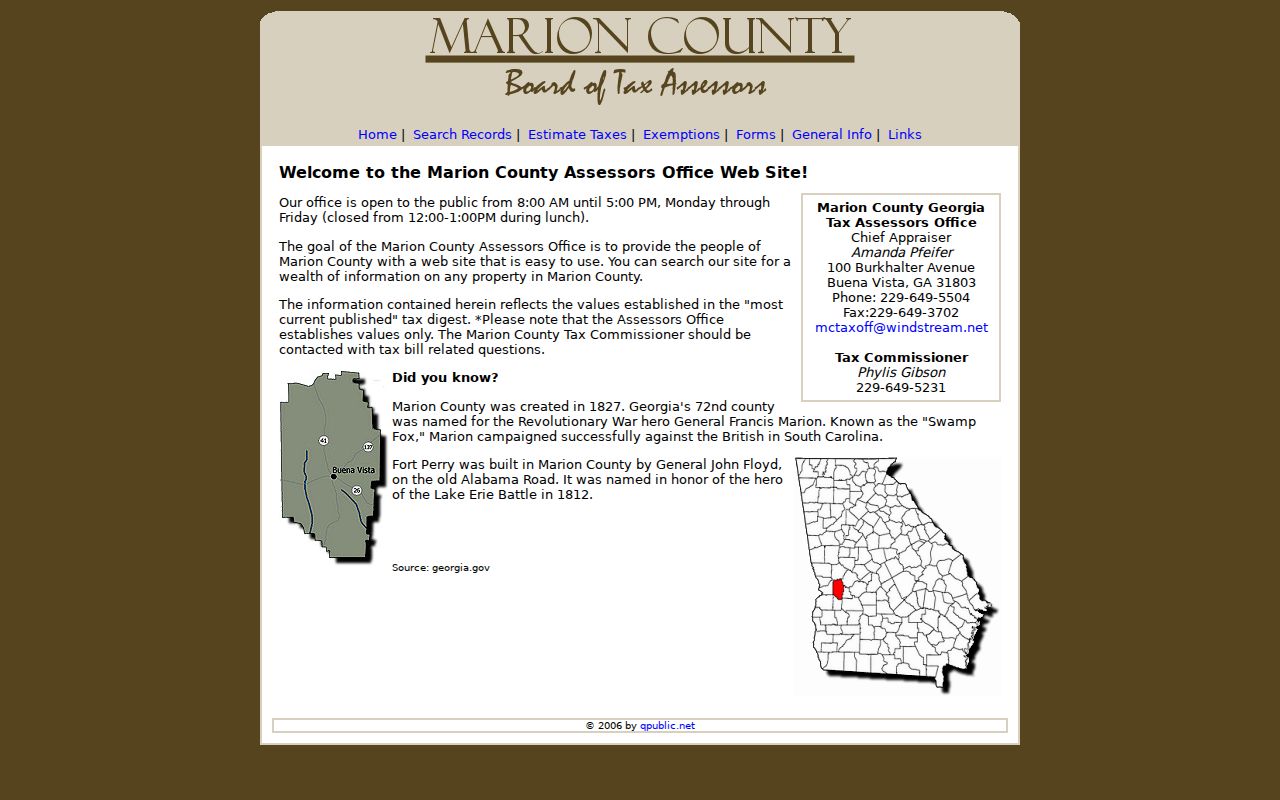
The county-published digest backs the parcel card, while the deed index supplies the separate confirmation step a careful ownership answer needs.
Official Sources Behind a Marion County Property Owner
No single source proves every part of ownership. The assessor is quickest for the current tax roll. The Clerk's deed index is strongest for the recorded transfer. State entity records then clarify a company name that appears as owner.
| Source | Owner Info It Gives | Access |
|---|---|---|
| QPublic tax roll | Owner name, mailing and situs addresses, parcel facts | Online search or assessor office |
| GSCCCA deed index | Grantee, grantor, instrument, date, book/page | Online index/account or courthouse terminal |
| Georgia eCorp | Entity name, status, agents, and filings | Public state search |
| Clerk and assessor counters | Older records, copies, and unresolved matches | In person, phone, mail, or records request |
Treat the tax mailing address as a contact clue, not proof of residence. A lender, trustee, company, estate representative, or out-of-county owner can receive the tax bill somewhere other than the parcel itself.
Trace a Marion County Owner to the Latest Deed
The GSCCCA real-estate name search takes a person in last-name, first-name order. It also takes party role, instrument type, county, optional neighboring counties, date range, result count, and display style. Search the assessor's name as grantee first. Then compare the legal description to the parcel you started with.
Marion's index is reported good from January 1, 1987. It carries a dynamic good-through date and lag. Images and deeper access may require an account. The courthouse terminal and the Clerk at 100 Broad Street offer an in-person route. The Clerk can locate and certify a deed, though not render a title opinion.
Note: Preserve the newest deed's recording date and book/page. The tax roll and deed index do not refresh on the same schedule.
Resolve Marion County LLC, Trust, and Estate Owners
A company or trust name on the parcel card may be the actual owner. It may not just be a placeholder for a person. Search the exact company through Georgia eCorp. Use Starts With, Contains, or Exact Match as needed. The entity record can supply a control number, status, registered agent, and dated filings.
Do not assume an agent's address is the parcel or the controlling person's home. For an estate, the Marion Probate Court file may identify a representative with authority to sell. The conveyance should still appear in the deed records. Ask by estate case number, decedent, approximate date, and property description.
Use Three Keys to Identify the Right Marion County Owner
Keep three keys together: situs address, parcel number, and legal description. The street address locates the site. The parcel number reconciles the tax records. The legal description tells the parcels apart when names or street labels overlap, which happens more often than you would expect.
- Owner of record
- The party named on the current assessment roll.
- Grantee
- The party receiving an interest in a recorded conveyance.
- Situs address
- The location of the land, which may differ from tax mail.
- Title
- The legal ownership interest, not established by one public index result.
Older rural records may describe land by lot, acreage, creek, road, or neighboring owner instead of a modern street number. Search that exact wording before trying any variants.
Treat Marion County Homestead as a Clue
A homestead or local exemption can suggest that an applicant treated the property as a primary home for a tax year. It does not prove who lives there now. Exemption rules, approvals, and timing belong with the assessor. Ownership confirmation belongs with the recorded deed.
Suppose a deed and parcel card disagree after a recent closing. Compare the recording date, the tax year, and the exact legal description. Then ask the assessor when the certified digest was updated. Do not trust whichever source simply looks newer.
Limits on a Marion County Ownership Lookup
An assessor name proves neither occupancy nor complete legal title. A recent deed can precede a tax-roll update, unrecorded interests may exist, and protected addresses may be redacted. Georgia VoteSafe can shield an eligible voter's residence for a four-year term, but it does not erase every deed already recorded in the deed records.
Lawful use. Ownership records support purchase, boundary, estate, and civic research. Never use an address or owner name to harass, threaten, or evade a protection.
Georgia's Open Records Act offers a fallback when a portal search stalls. Ask for an existing parcel card or a deed copy by naming the parcel, the record type, and a date range. The agency can redact protected details. It still has to produce the rest of the public record, though it need not build a fresh ownership report.
Older deed images sometimes never made it online. The Clerk can be reached at 229-649-7321 or at the courthouse on 100 Broad Street, and staff can say whether a paper book, microfilm, a courthouse terminal, or an archive holds the item. For a parcel card question, the assessor's line is 229-649-5504, and the appraisal office takes walk-ins. QPublic permits no unattended use, and GSCCAA image access can require an account, so these direct channels still matter.
What if the deed and the roll disagree? Match the newest recording date, the legal description, and the parcel identifiers to confirm you are looking at the same land. Then ask the assessor when the digest absorbed the transfer. The deed is the stronger record of a fresh conveyance. The tax roll is still the practical current snapshot.
An apparent dead end often is not one. Search names in last-name, first-name order. Try initials, spouse names, trustee wording, estate styles, and exact company variants. A query limited to Grantor will miss a party listed only as Grantee. Check Marion's good-from and good-through dates before deciding no instrument exists.
Some ownership evidence predates any online span. FamilySearch catalogs Marion deed and mortgage material from 1845 through 1965. Georgia Archives publishes guidance for county microfilm research. Both may require browsing by book rather than a full-text name search, and the Clerk can confirm whether an older reference still sits in a courthouse deed book or on local microfilm.
A recorded plat can untangle a same-name or address mix-up by tying the deed to the right subdivision, lot, block, land lot, or road. It cannot establish the current owner by itself. Keep the conveyance, the assessor snapshot, and the plat in their proper roles.
Estates complicate ownership too. Marion Probate Court may hold a petition, a will, an appointment, an inventory, an annual return, heir details, or authority for a sale. Those files explain why an executor or administrator appears on the record. They do not replace the recorded conveyance, so trace any completed transfer back to the Clerk's index.
Litigation can also interrupt a simple answer. Marion Superior Court, part of the Chattahoochee Judicial Circuit, hears quiet-title, partition, foreclosure, lien-enforcement, and similar land cases. Georgia Courts eAccess is the state's doorway, and it carries account requirements. The local Clerk remains the fallback for a party-name or case-number search.
Save the source date with every result. A current roll, a deed index entry, an entity filing, and a court docket can each be accurate for its own date yet describe different stages of one transaction.
The strongest answer names both the source and its limit. The assessor identifies the owner carried for taxation. The newest deed identifies the recorded grantee. An entity or probate file explains who may act for that named owner. When these records conflict, preserve the tension rather than forcing a conclusion. A title professional can examine interests that no public index resolves.