
Trace Former Marion County Property Owners
Lay out a reverse transfer timeline with one instrument per row, and keep the full legal description in view beside it so the chain never drifts off the land.
| Source | Coverage | Access point | Historical clue |
|---|---|---|---|
| GSCCCA deed index | January 1, 1987 forward | Web or courthouse terminal | Grantor, grantee, type, date, locator |
| Deed and mortgage books | 1845–1965 cataloged run | FamilySearch, clerk, archives | Earlier transfers and citations |
| Recorded plats | Verify by subdivision/reference | GSCCCA or clerk | Lot, block, road, right of way |
| Probate files | Event-specific | Probate Court | Authority, estate, heirs |
Start at the newest deed and work backward. Street numbers change, and one owner may hold several tracts, so the lot, block, plat caption, acreage, and prior-deed references are what keep every step tied to the same piece of Marion County ground.
Marion’s Online Ownership Depth Starts in 1987
The county GSCCCA status page lists January 1, 1987 as the good-from date. The good-through date shifts as indexing catches up. Recent Marion County deed records can sit a few days behind the counter. That line is digital only. Ownership in Marion County runs far deeper than 1987. Many later deeds cite an older book and page, and each citation hands you a bridge into the courthouse volumes or microfilm.
Online cutoff. Former owners before January 1, 1987 may require deed books or microfilm even when the modern chain appears online.
Walk the Marion County Deed Chain Backward
Use the GSCCCA Real Estate Index by turning each seller into the earlier buyer. Try initials, spouses, trustees, estates, and company suffixes, and discard any hit whose legal description does not match the parcel you are chasing through Marion County property records.
- Locate the newest deed with the present acquirer as grantee.
- Record the grantor, date, type, locator, and legal description.
- Search that grantor as an earlier grantee and match the same land.
- Repeat, carrying the last citation into old books when online coverage ends.
- Grantor / grantee
- The conveying and receiving parties.
- Chain of title
- Ordered instruments affecting the same land.
- Reverse index
- A route organized through conveying parties.
- Legal description
- The land identity that survives address changes.
- Warranty / quitclaim
- Different forms; neither label alone proves clean title.
Filter Former Marion Owners by Instrument
Filter the results by instrument. Warranty, quitclaim, executor, administrator, tax, and corrective deeds each move or explain the chain differently. Security deeds, assignments, liens, and releases touch the land without acting as ordinary purchase transfers. Read the filing itself. Never infer legal effect from an index label alone.
Estates and trusts can make a link look broken because the indexed party changes mid-chain. Probate files may name the authority or the heirs. But the recorded conveyance remains the deed-record proof of who owned the parcel. Search company names with spelling and suffix variants. Marion County deed records often index them inconsistently.
FamilySearch Extends Marion Deeds to 1845
The FamilySearch catalog covers Marion deed and mortgage records from 1845 through 1965. Access ranges from browse-only images to affiliate logins to microfilm. The Georgia Archives offers county-record guidance as well.
Ask the clerk about the older book run, the index arrangement, and how retrieval works. Whether by phone, counter, or mail, bring names and approximate dates. Include book and page citations and the legal description. A focused Open Records Act request works when ordinary channels stall. Describe one specific existing record.
Pair Prior Marion Owners with Historic Plats
The GSCCCA Plat Index ties a subdivision caption, lot, block, road, or easement back into your chain. Marion County plats matter here. Liberty Crossing, Liberty Trace, and Hidden Canyon Court records show why road conveyance and maintenance evidence can span plats, deeds, and minutes at once. A plat supports identification. It does not list every owner through time. Use it to reject a same-name deed for some other tract and to decode abbreviated legal descriptions in the Marion County property records.
Sanborn Maps Bridge Old Buena Vista Addresses
Buena Vista addresses shift over time. The 1904, 1909, and 1924 Sanborn sets from the Digital Library of Georgia capture that change block by block. Footprints, lot numbers, and street grids in these fire-insurance maps can tie a vanished address to a specific block. That gives Marion County researchers a foothold before they return to plats and deed records at the recorder's office.
Treat the maps as context, never as proof of who held title. Some early Marion County records also name Horry or Tazewell. The county seat moved before Buena Vista became the lasting one.
Resolve Missing Marion Deed Images
GSCCCA's 2025 updates describe historical re-indexing and a process for reporting missing images. A blank image is a follow-up clue, not proof a transfer never happened. Save the parties, county, date, instrument type, and locator.
Contact the Marion County Clerk for a courthouse terminal. The office can also pull an older volume or issue a certified copy. Ask about current procedures and fees, since charges are not fixed.
How Far Back Marion County Ownership Records Go
The trail can reach back to 1845. It will not read as one seamless chain, though. Estates, tract divisions, name changes, missing images, shortened legal descriptions, and unrecorded interests all interrupt a tidy sequence of Marion County property records.
Evidence boundary. Former-owner research supports house history and property diligence, but is not a title opinion. Never use personal information to stalk, harass, or harm anyone.
Where money, construction, access, inheritance, or a dispute turns on the answer, a professional title examination is worth the cost.
Build a Marion County Ownership Research Packet
A reproducible former-owner search preserves its own evidence. For every transfer, keep the index result, the deed itself, the date, instrument type, and locator. Keep the legal description too, plus a note on why it matches the parcel. Add the plat whenever a subdivision caption appears. If an estate intervened, record the probate clue without assuming probate alone conveyed the land.
Mark uncertainty plainly. A name match can stay tentative. A missing image stays pending until the clerk retrieves it. A road name stays an orientation clue until a plat ties it to the tract. Labeling each item keeps a plausible story from hardening into an unsupported chain. It also makes courthouse work efficient. Staff receive specific names, dates, and locators instead of a vague request.
Tax digests, directories, newspapers, and Sanborn maps can corroborate association with a site. But they never replace recorded transfers. QPublic is a fine way to start the backward search. Yet it can lag a newly recorded deed. When systems disagree, the latest recorded grantee is the better lead in Marion County property records.
Note: Keep confirmed transfers, contextual clues, and unresolved gaps in separate columns.
When Probate Explains a Former Marion Owner
A death can interrupt the chain of title without any sale taking place. Probate records often explain why. Search the former owner, executor or administrator, heirs, and trust name variants. Marion Probate Court may hold estate material. The Superior Court clerk holds the land instrument itself.
Probate establishes authority. The recorded deed supplies the conveyance and legal description. Match an executor deed to the parcel like any other link. If interests passed without an obvious instrument, professional title help may be worth getting.
Business entities create similar breaks in Marion County property records. Check the Georgia eCorp Business Search for exact and prior names, then return to GSCCCA. An entity record does not prove what property it owned.
See the Marion County Name Index
The GSCCCA name-search page displays the grantor, grantee, county, instrument, and date controls used to reconstruct former ownership in Marion County.
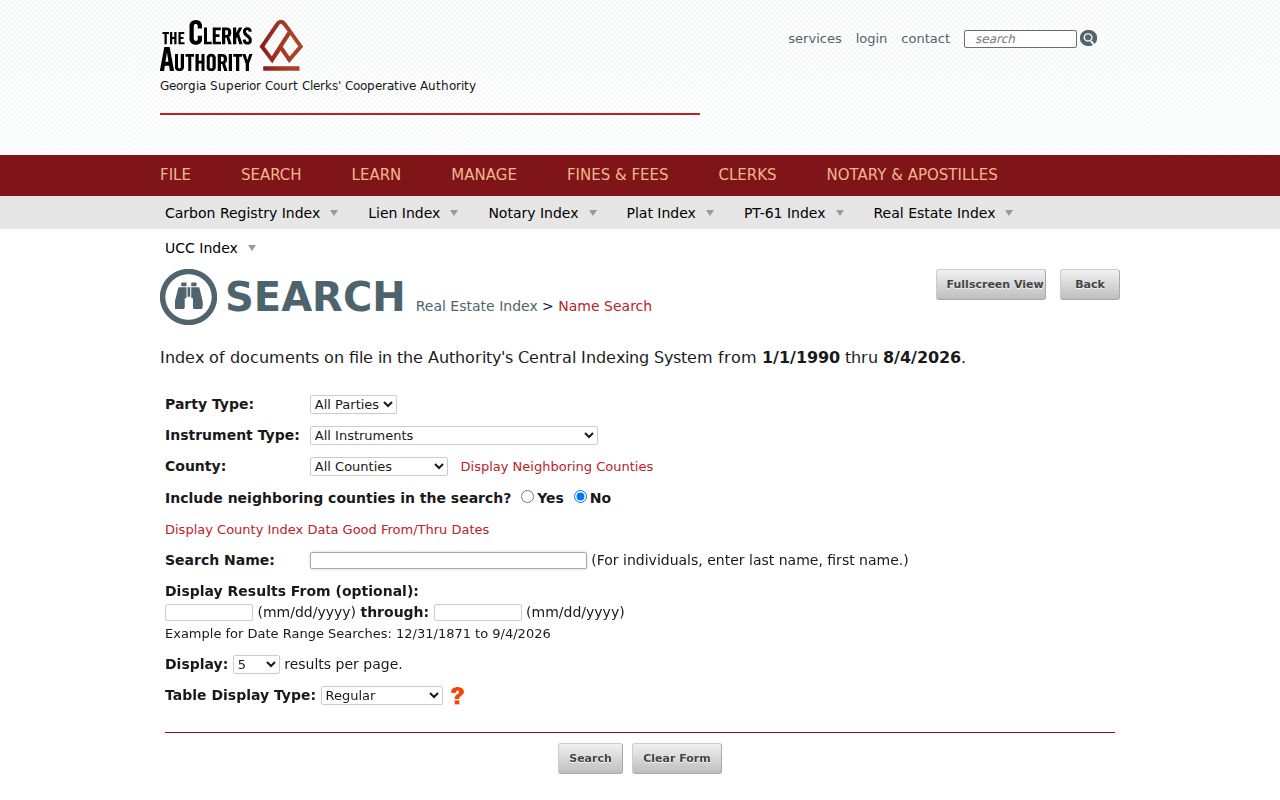
The name index points to possible transfers. Confirm each match against the recorded deed and its legal description before adding it to a parcel's history in the Marion County property records.