
What Marion County Deed Records Convey
A recorded deed names the parties. It also gives a recording date, states its instrument category, and carries a reference for pulling the filing. The legal description matters most. It, not the address, ties the deed to the land. Marion County's clerk also records security instruments, liens, plats, and UCC filings beside deeds. Each type does different work in the property records.
| Instrument | Legal effect to investigate | Typical research use |
|---|---|---|
| Warranty deed | Conveys an interest with stated warranties | Ordinary sale trail |
| Quitclaim deed | Conveys whatever interest the signer holds | Family transfer or title cleanup |
| Executor or administrator deed | Conveys through an estate representative | Probate-connected transfer |
| Tax deed | Documents a tax-sale conveyance | Delinquent-tax history |
| Security deed | Secures a debt rather than conveying beneficial ownership as a sale | Lien and release research |
Labels are leads, not conclusions. Read the actual instrument, compare later corrective filings and releases, and match the land description across the whole chain.
Search Marion County Deeds in GSCCCA
The GSCCCA Real Estate Index is the online front door for Marion County deed records. It works as a party-name index. Start with the person or entity that granted or received an interest. It is not an assessor address search.
| Search control | How to use it | Why it matters |
|---|---|---|
| County | Select Marion | Prevents same-name results from other Georgia counties |
| Party type | Choose grantor, grantee, or both | Separates giving from receiving |
| Name | Try surname, initials, spouses, trustees, and entity variants | Indexing follows recorded names |
| Instrument type | Narrow to deeds or related filings | Reduces unrelated instruments |
| Date range | Bracket a known sale or estate event | Creates a manageable result set |
Deeper access and images may require an account. When the online trail ends at an index entry, a courthouse terminal and the clerk's staff are practical alternatives.
Marion County’s Online Deed Window Begins in 1987
The county-specific GSCCCA status page reports a good-from date of January 1, 1987 for Marion County deed records. That local date is more precise. The statewide 1990 statement is less precise. The good-through date and indexing delay shift as the clerk posts new filings, and the lag has run about five days, so check again when recency matters.
A missing hit before 1987 does not mean no deed existed. The search has crossed into the older deed-book and microfilm trail. Preserve every book-and-page citation from later instruments. Those citations can point directly into the older collection.
Note: Check the live good-through date before treating a recent closing as absent from Marion County deed records.
Walk the Marion County Grantor-Grantee Chain
A backward chain reverses each former seller's role. Keep the legal description beside the name search. Similar names and multiple holdings can otherwise push the chain onto unrelated land.
- Find the newest purchase instrument with the current acquirer shown as grantee.
- Read the grantor, recording date, instrument type, and book/page or instrument reference.
- Search that grantor as an earlier grantee and locate the deed by which that person acquired the same legal description.
- Repeat until the online date boundary, then carry the references into deed books or microfilm.
- Grantor
- The party conveying an interest.
- Grantee
- The party receiving the stated interest.
- Chain of title
- The ordered sequence of instruments affecting the same land.
- Book/page or instrument number
- A retrieval locator, not an opinion about ownership quality.
A break is rarely final. Estate transfers, trusts, business entities, name variations, and corrective deeds explain many gaps, and some instruments sit in unexpected categories. Probate records can explain authority.
Historic Marion Deeds Extend to 1845
The FamilySearch catalog describes Marion County deed and mortgage records from 1845 through 1965. Access varies. Images may be browse-only, limited to an affiliate library, or restricted on microfilm. Treat it as a guide, not a promise.
The Georgia Archives research guidance covers county-record microfilm and FamilySearch access. The Marion County Public Library can also point to local-history resources and access points. Watch old place names carefully. Marion County's seat shifted from Horry to Tazewell and then Buena Vista, so an early reference need not resemble the current address.
Plats Clarify Marion County Lots and Roads
A deed's subdivision caption, lot, block, acreage, road reference, or metes-and-bounds call can be checked against the GSCCCA Plat Index. The index is a starting point. Plats reveal dedicated roads and rights of way. They also show easements and the geometry behind a short deed description.
Marion County kept a paper trail on Liberty Crossing, Liberty Trace, and Hidden Canyon Court. Its 2020 agenda and minutes on those roads show why the paper trail matters. Visible public use settles little by itself. It does not reveal who conveyed a roadway. It also leaves open whether the county accepted it, and who bears maintenance now. For Pineville Road-area work, request the plat first. Then add the dedication or conveyance, later acceptance, and related minutes.
When a Marion Deed Image Is Missing
GSCCCA's 2025 updates describe historical re-indexing and a process for reporting missing images. In other words, online access is an evolving layer. Official filings sit beneath it. Before following up, record the exact county, party names, date, document type, and index reference.
Then contact the Marion County Clerk of Superior and Juvenile Court. The clerk can confirm the index reference. Staff can explain courthouse-terminal access, locate an older book, and state the current procedure and cost for plain or certified copies. Get the fee from the clerk directly. An old fee schedule may not apply.
Note: A blank web image is a retrieval problem, not proof that the indexed filing never existed.
FANS Watches New Marion County Filings
Georgia's Filing Activity Notification System can send notice when filings match a registered name. Think of it as an early-warning tool. It flags unexpected deed, lien, or related activity. But it does not prevent recording, confirm identity, or replace periodic review of the official index.
Name selection matters. Register spelling variants and entity names where the service permits. A notification is only the first step. Pull the clerk record and the actual instrument before drawing any conclusion. That is the difference between watching a name. And it is how you prove a filing affects a particular Marion County parcel.
Obtain a Marion County Deed Copy
Start with an online index entry or a search at a courthouse terminal. Write down the party names, the recording date, the instrument type, and the complete locator. When an image is available under the applicable GSCCCA access terms, open it and read the legal description, execution details, references, and exhibits. When no image appears, or the deed sits in an older volume, or you need a certified copy, ask the clerk at the courthouse.
Call ahead about hours, identification, payment methods, copy charges, mail requests, and turnaround. The clerk's office publishes no dedicated deed request form and no fixed local fee. A focused written request can cite the Georgia Open Records Act, O.C.G.A. §§50-18-70 through 50-18-79, when ordinary counter or mail channels do not resolve an identifiable public record.
Recorded does not mean guaranteed. The Marion County index reports filed instruments; it is not a boundary survey or title opinion, and unrecorded interests may exist.
A purchase or a dispute calls for a professional. A qualified examiner can trace the full chain, exceptions, releases, probate events, and competing legal descriptions in Marion County deed records. The online entry is only the starting locator for that deeper review, never the end of it.
View Marion County’s Deed Search Screens
The official GSCCCA name-search screen shows the party, county, instrument, and date controls behind Marion County deed records. Each control narrows the hunt for a specific deed.
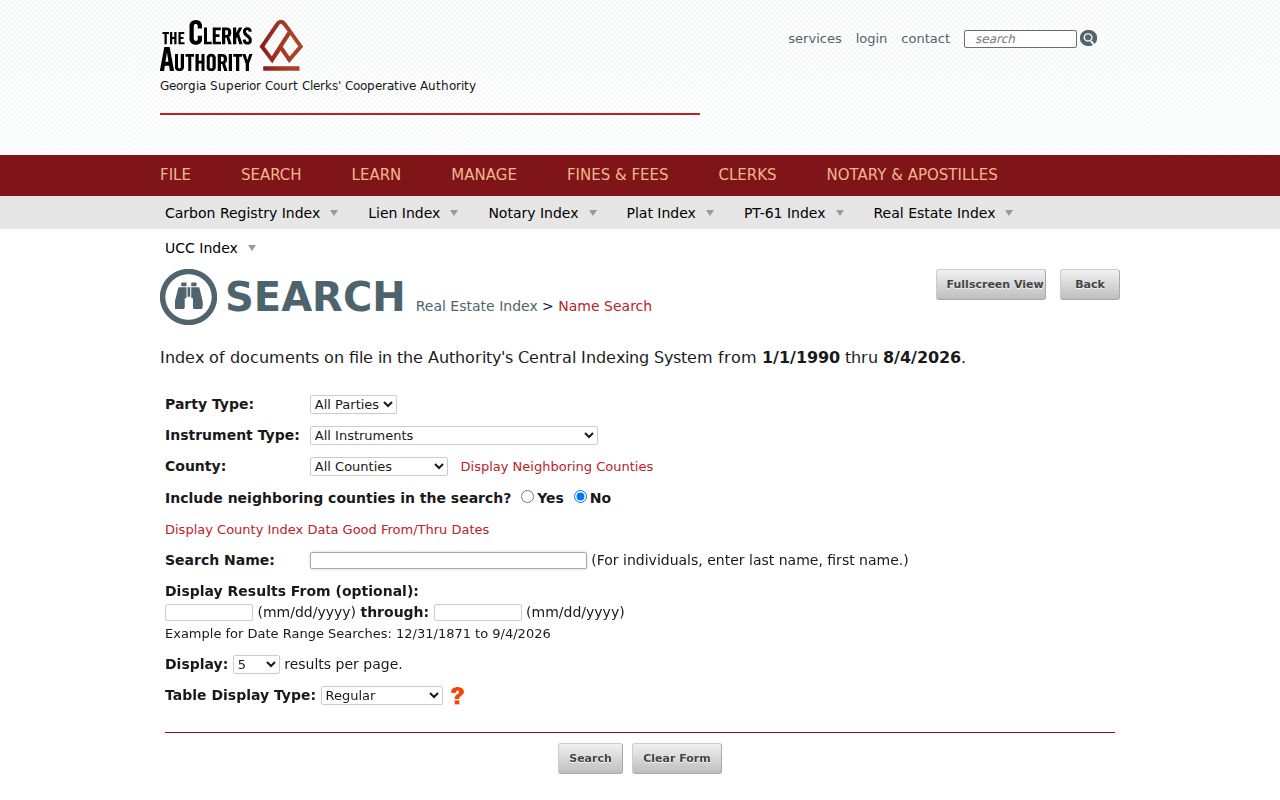
The form finds candidate filings. The instrument itself, along with its legal description, decides whether a hit belongs to the parcel in question. The separate Marion coverage-status page reports the index window and the current lag.
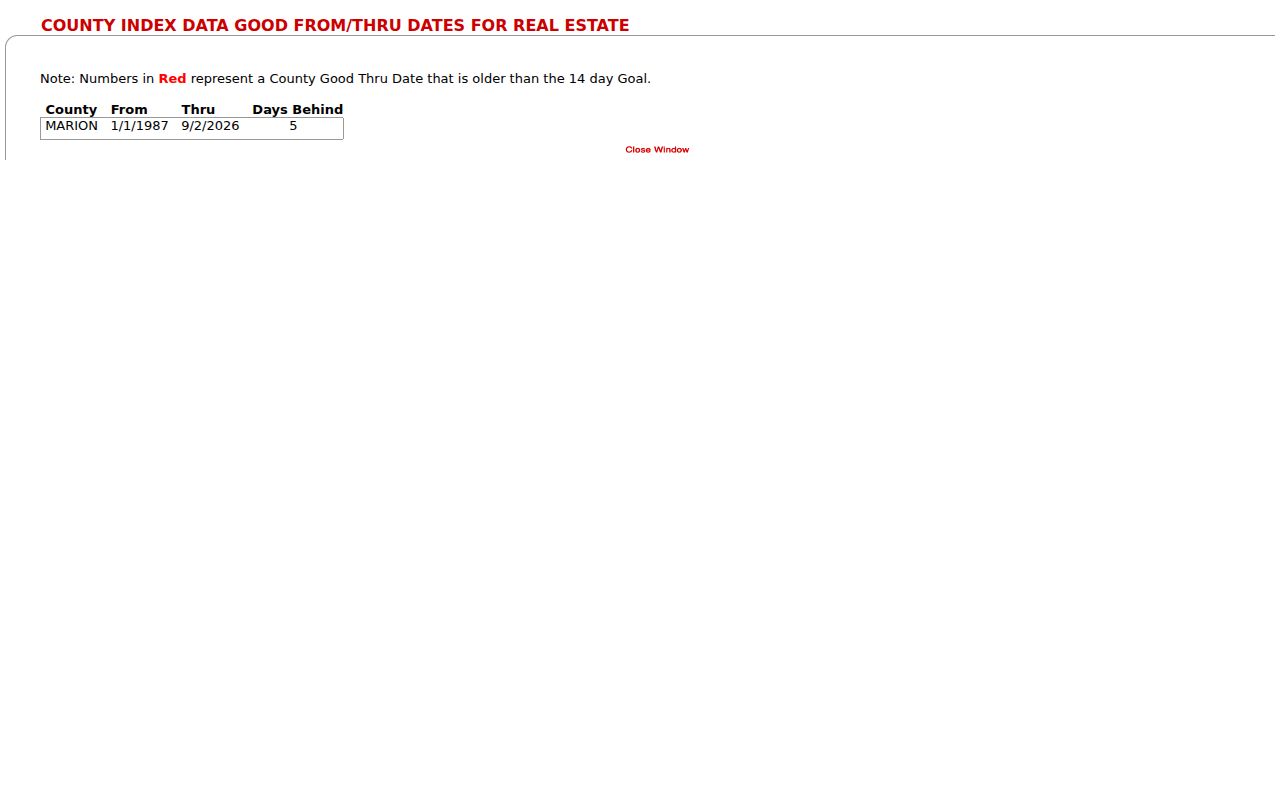
The through date moves, so check the live page whenever a recent recording seems missing.